
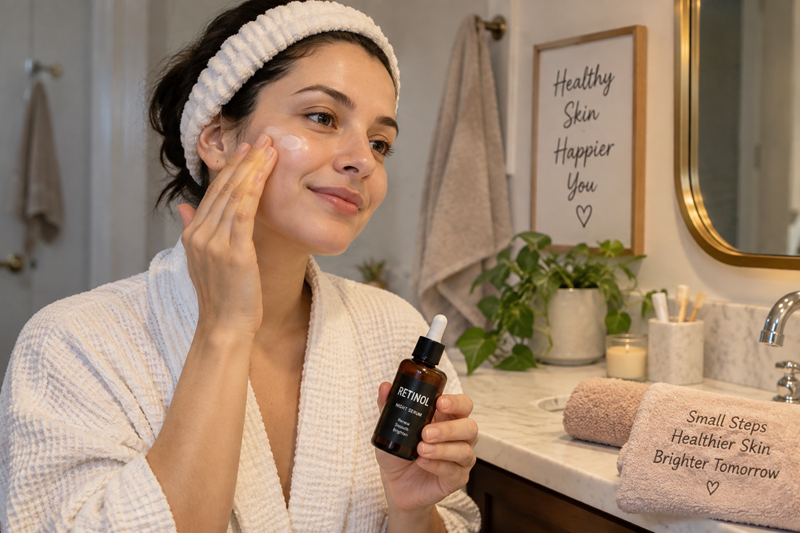
Retinol can be an effective addition to a skincare routine, but using it more often does not necessarily mean getting better or faster results. For someone new to retinol, starting slowly is usually the more sensible approach. The right frequency depends on the product, its strength, your skin's tolerance, and whether you have used retinoids before.
So, how often should you use retinol? For many beginners, starting a few nights per week and gradually increasing use as the skin adjusts can be a practical approach. The goal is consistent use without creating unnecessary irritation.
How Often Should Beginners Use Retinol?
If you have never used retinol before, applying it every night from the beginning can be too much for your skin. Retinol may cause temporary dryness, peeling, redness, or sensitivity, particularly when the skin has not yet adapted.
A common approach is to begin with retinol a couple of nights per week, leaving recovery days between applications. If your skin remains comfortable, you can gradually increase the frequency. Dermatologists at the American Academy of Dermatology similarly recommend starting gradually, including starting retinol every other night, to help reduce irritation.
There is no need to rush the process. If using retinol twice a week gives you good tolerance, there is little reason to increase the frequency simply because someone else's routine calls for nightly use.
Can You Use Retinol Every Night?
Yes, some people can eventually use retinol every night. However, nightly application is not a requirement for everyone.
Your skin's response is more useful than a calendar when deciding whether to increase frequency. If your current routine causes persistent dryness, burning, redness, or peeling, using retinol more frequently is unlikely to make the situation better.
On the other hand, if your skin has comfortably adapted to your current schedule, you may be able to increase use gradually. Some people may settle into every-other-night application, while others may tolerate nightly use.
The important distinction is that more frequent use is not automatically better use.
What Happens If You Use Retinol Too Often?
Using retinol too frequently can overwhelm your skin's ability to tolerate the ingredient. Instead of producing faster improvements, excessive use may leave the skin feeling dry, tight, irritated, or unusually sensitive.
Peeling can also occur, but visible peeling should not be treated as evidence that retinol is “working better.” Persistent irritation is a reason to reconsider the routine rather than increase the dose or frequency.
If your skin becomes uncomfortable, reducing how often you apply retinol or taking a temporary break may be more appropriate than continuing at the same frequency. A 2024 review of cosmetic retinoids also highlights tolerability and irritation as important considerations when using topical retinoid ingredients.
Does Retinol Strength Affect How Often You Should Use It?
It can. The concentration of retinol is one factor to consider, but it isn't the only one. Product formulation, skin sensitivity, previous retinoid experience, and how your skin responds can all influence an appropriate routine.
A stronger product isn't automatically a better product for every person. Increasing the concentration and frequency at the same time can also make it harder to determine what is causing irritation.
It's also important not to compare different retinoids solely by the percentage printed on the package. Retinol, retinaldehyde, prescription retinoids, and other cosmetic retinoids are different compounds with different characteristics. Research reviewing different types of retinoids highlights differences in efficacy, tolerability, and formulation.
That is also why someone comparing granactive retinoid v retinol shouldn't assume that the percentages of the two ingredients can be directly converted into equivalent strengths.
How Long Does Retinol Take to Work?
One reason people sometimes overuse retinol is impatience. They apply it once or twice, see little change, and assume they need to use it more often.
Retinol generally requires consistent use and time. Results also depend on what you are trying to improve. Texture, uneven tone, fine lines, and other signs of photoaging do not necessarily change at the same rate.
Clinical research on retinol provides some useful perspective. A 2024 pooled analysis of six vehicle-controlled studies involving stabilized 0.1% retinol found improvements in signs of photoaging beginning around week four and continuing through week 12. You can read the full clinical research on retinol for the study details.
In other words, increasing frequency simply because you haven't seen immediate results isn't necessarily the answer.
Can You Use Retinol With Other Skincare Products?
Retinol doesn't have to be the only active ingredient in your skincare routine, but beginners should be careful about combining several potentially irritating products at once.
A gentle cleanser and moisturizer can help keep the routine simple. If you already use ingredients such as exfoliating acids, introducing retinol gradually can make it easier to identify what your skin tolerates.
Vitamin C can also have a place in a skincare routine, but there is no need to layer every active ingredient into the same application. Similarly, combining multiple retinoid products is generally unnecessary and may increase the potential for irritation.
A simple routine that you can use consistently is often more useful than an ambitious routine that repeatedly leaves your skin uncomfortable.
Quick Answers About Retinol Frequency
Can I use retinol twice a week?
Yes. Twice-weekly use can be a reasonable starting point for someone new to retinol, particularly if their skin is sensitive.
Can I use retinol every other night?
Yes. Every-other-night use is a commonly used gradual schedule and may be enough for someone who doesn't tolerate nightly application.
Should I use retinol in the morning?
Retinol is generally used at night. During the day, broad-spectrum sunscreen is important because sun exposure can contribute to skin aging and undermine an anti-aging skincare routine.
What should I do if retinol irritates my skin?
Don't automatically increase frequency or push through significant irritation. Consider reducing use or pausing until your skin feels comfortable again. If irritation is severe or persistent, speak with a dermatologist or other qualified healthcare professional.
The Bottom Line
The best retinol schedule isn't necessarily the one that uses retinol most often. It is the schedule your skin can tolerate consistently. Start gradually, pay attention to how your skin responds, and increase frequency only when your current routine feels comfortable. With retinol, patience and consistency are usually more useful than trying to accelerate the process.